Kelsey Mitchell's 2027 free agency: three teams, three paths to the Finals

At an unchanged $7 million cap, Golden State could add Kelsey Mitchell and have $45,672 left above minimum roster charges. That cushion is $800,972 at the $7.91 million ceiling. Las Vegas fits her at a lower cap if Jackie Young leaves. Indiana's first-year supermax is $210,000 above an outside team's standard maximum at $7 million, and $237,300 above it at $7.91 million.
What each team could afford
Here is what signing Mitchell would leave at three caps, after minimum charges to reach 12 players:
Golden State signs Mitchell
Las Vegas signs Mitchell; Young leaves
Las Vegas signs Mitchell; Young returns at 20% of cap
Atlanta signs Mitchell; keeps nine listed contracts
| Team and scenario | Balance at a $7.00M cap | Balance at a $7.50M cap | Balance at a $7.91M cap |
|---|---|---|---|
| Golden State signs Mitchell | $45,672 | $460,672 | $800,972 |
| Las Vegas signs Mitchell; Young leaves | $100,800 | $415,800 | $674,100 |
| Las Vegas signs Mitchell; Young returns at 20% of cap | -$1,010,600 | -$795,600 | -$619,300 |
| Atlanta signs Mitchell; keeps nine listed contracts | -$948,030 | -$533,030 | -$192,730 |

Source: FCB calculations from Her Hoop Stats 2027 contract columns and the signed CBA. Data through November 7, 2026 (PST). Methods: Mitchell at 17 percent of the cap, Wilson at 20 percent for Las Vegas, and a $288,600 charge on each open spot through 12 players. The columns are a $7 million unchanged cap, a $7.50 million sensitivity case, and the $7.91 million ceiling. Download CSV (CC0)
A positive balance is money left for an upgrade above those minimums. A negative balance is the shortfall in this veteran-filled model. Player salary inputs and trade scenarios use the same contracts.
Where each roster first fits
A salary-clearing move can work under one cap and fail under another. These are the cap levels at which each proposed roster first fits, including minimum-cost replacements.
| Proposed roster | Break-even cap | Inside the $6.09M to $7.91M range? |
|---|---|---|
| Las Vegas signs Mitchell; Young leaves | $6,839,998 | Yes |
| Golden State signs Mitchell; keeps seven contracts | $6,944,973 | Yes |
| Atlanta signs Mitchell; trades Jones for no salary | $7,254,975 | Yes |
| Atlanta signs Mitchell; trades Hillmon for no salary | $7,465,819 | Yes |
| Atlanta signs Mitchell; trades Canada for no salary | $7,706,782 | Yes |
| Las Vegas keeps Young at 20%, signs Mitchell, trades Loyd and Evans for no salary | $7,811,161 | Yes |
| Las Vegas keeps Young at 20%, signs Mitchell, trades only Loyd for no salary | $8,067,903 | No |
| Atlanta signs Mitchell; keeps nine contracts | $8,142,204 | No |
| Las Vegas keeps Young at 20% and signs Mitchell; no trade | $9,350,231 | No |
Source: FCB calculations from the same contract inputs and the signed CBA. Data through November 7, 2026 (PST). Methods: the smallest whole-dollar cap at which the scenario formula is no longer negative. Seventeen percent of the cap is cap times 17, divided by 100 in whole dollars. Twenty percent is the cap divided by 5 in whole dollars. Each open spot, including a replacement for a departed player, costs $288,600. Download CSV (CC0)
Golden State is still the preferred basketball fit, because the seven contracted players include an All-Defensive core. The budget result is separate. Las Vegas without Young first fits at $6,839,998, which is below Golden State's $6,944,973. At an unchanged $7 million cap, that Las Vegas roster also has more left over: $100,800, against Golden State's $45,672.
The signed agreement lets a team send qualifying offers from January 30 through February 3, opens negotiations on February 4, and allows new contracts to be signed starting February 16, the day after the 2026-season moratorium ends (CBA). On October 23, 2026, Pacers Sports & Entertainment announced that Kelly Krauskopf will step down as Fever president and that general manager Amber Cox is departing, effective immediately (Krauskopf; Cox).
Why Mitchell changes the conversation
Mitchell averaged 24.7 points in 2026 while shooting 50.9% from the field, 45.0% from three and 85.1% at the line. Her 1,086 regular-season points established a WNBA record (Mitchell statistics; WNBA records).
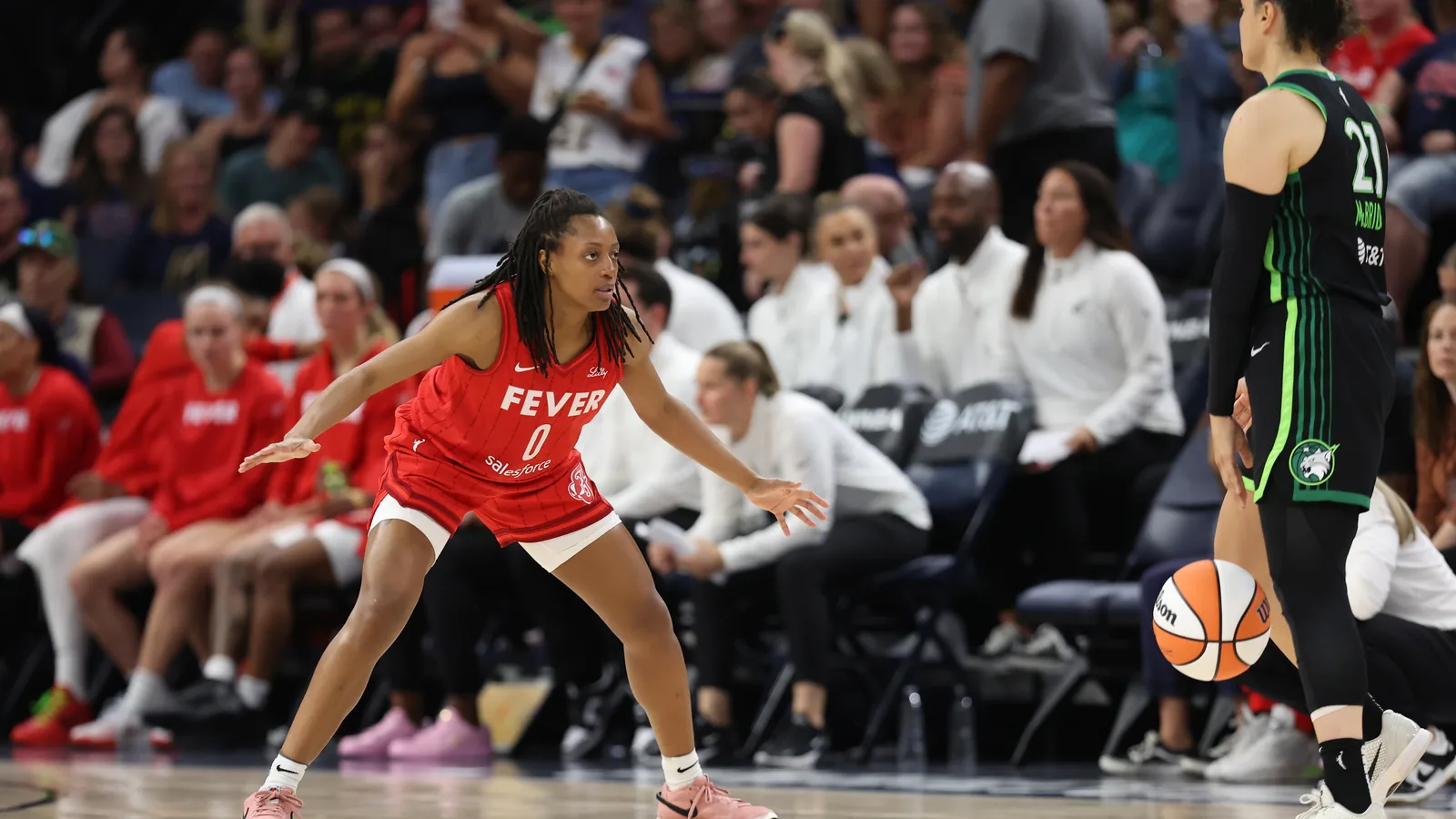
Her scoring is not confined to one area. FCB's calculation from her season totals assigns 492 points to two-point baskets, 405 to threes and 189 to free throws. Her effective field-goal percentage was 60.0%, reflecting the additional value of her made threes (Mitchell statistics).
For a contender, the practical appeal is having another player whose defender must stay engaged. Mitchell could attack space created by a teammate, occupy a defender away from the main action, or take responsibility when a possession runs short of time.
An Indiana Fever release credits Caitlin Clark with 96 assists to Mitchell out of 333 total assists, or 28.8%. That describes where Clark's assists went. It does not tell us what percentage of Mitchell's scoring depends on Clark or what would disappear if she left (Fever release).
Mitchell also shot 18-for-55 in Indiana's three-game playoff loss to Las Vegas. Three games cannot settle a player's postseason value, but they illustrate why a contender should preserve other ways to initiate offense (Mitchell statistics).
The best fit would offer more than a second famous scorer. It would offer passing, screening, spacing and a defense that can keep the team competitive when her jumper is not falling.
Golden State: give a championship defense more ways to score
Golden State won 32 games and the 2026 championship. Basketball-Reference's possession estimates ranked it first defensively and seventh offensively. Adding an elite scorer would address the less dominant side of an already successful team (team statistics; WNBA playoffs).
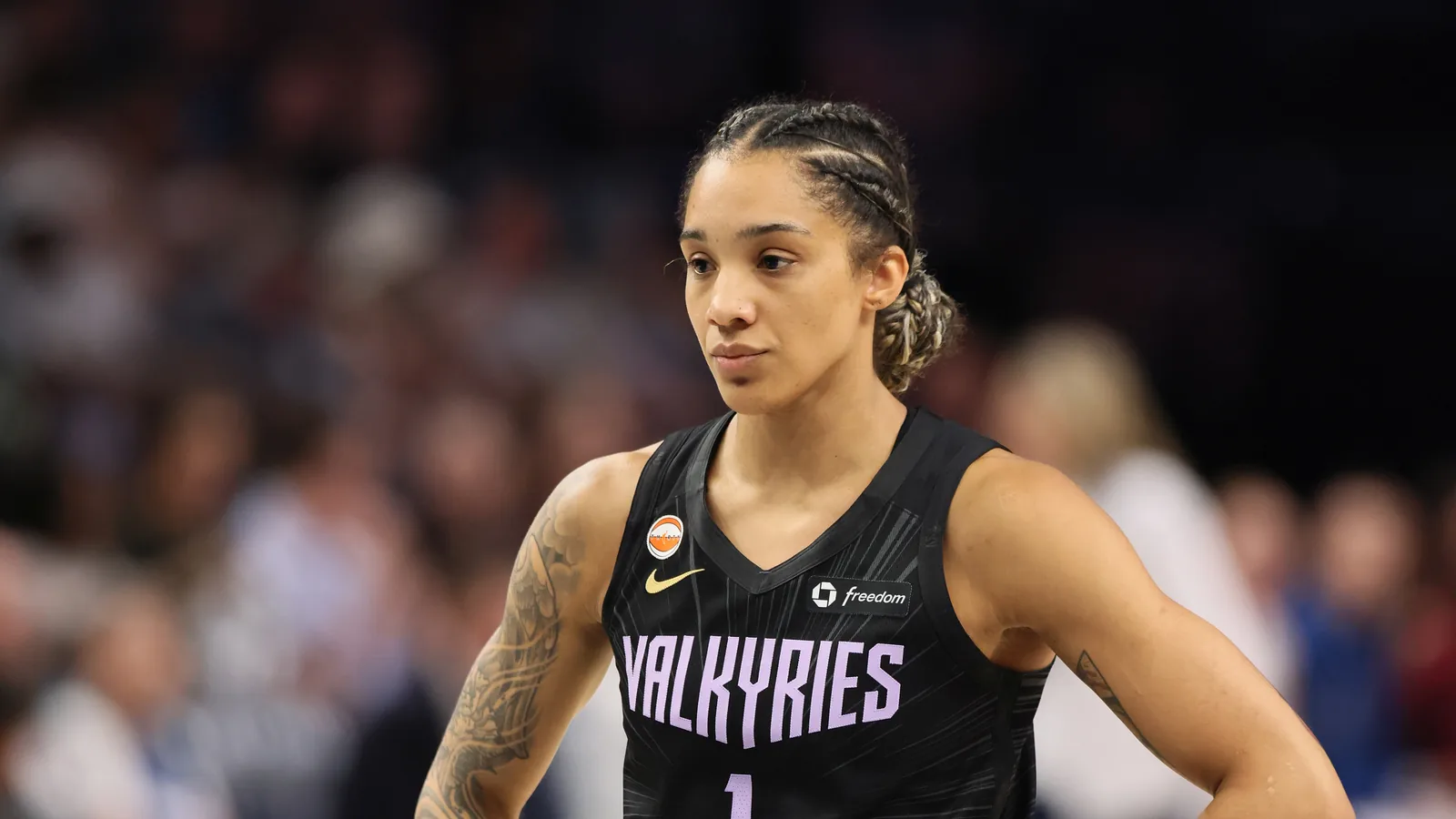
The contracted personnel are a major part of the appeal. Gabby Williams, Veronica Burton and Kiah Stokes earned 2026 All-Defensive honors. All three appear on Golden State's 2027 contract list, alongside Janelle Salaün, Kaila Charles, Iliana Rupert and Justė Jocytė (contract sources; All-Defensive selections).
A proposed closing lineup is Veronica Burton, Kelsey Mitchell, Gabby Williams, Janelle Salaün and Kiah Stokes.
This version gives Mitchell an organizer next to her, defenders who can take difficult initial assignments, and an interior presence behind the perimeter.
The first offensive objective would be to make the defense react before Mitchell needs to create a shot. Burton could initiate a possession that sends Mitchell around a screen. If the defense chases, Mitchell could turn toward the basket. If two defenders step toward her, the pass out should give Williams or another teammate a brief advantage against a rotating defense.
A second option would use Mitchell as a screener. If she screens for Williams and then moves back to the perimeter, defenders must decide whether to switch, stay attached, or send help. The action matters because it makes both players part of the same decision rather than asking them to take turns.
The risk is spacing around the action. If an opponent can leave another player unattended, it can crowd Mitchell without paying much of a price. Stokes's defensive value would need to be weighed against how the opponent guards the other end.
That creates a second closing possibility: Charles replaces Stokes, with Salaün handling center responsibilities.
The smaller group could provide more movement and different screening combinations. It would not automatically provide five credible shooting threats. That depends on which players the opponent is willing to leave and how effectively they punish that choice.
It would also have to rebound. A lineup that improves shot creation but surrenders repeated second chances may not improve the team.
What Golden State would sacrifice
The model keeps the seven listed contracts, not every member of the championship rotation. Tiffany Hayes and Kayla Thornton are unrestricted free agents; Cecilia Zandalasini is restricted. Their returns would need to be funded from the remaining budget (contract sources).
Four minimum positions are already in the model. The money above them is $45,672 at an unchanged $7 million cap, $460,672 at $7.50 million, and $800,972 at $7.91 million. Putting the entire surplus into one open spot, and leaving the other three at $288,600, would pay $334,272, $749,272, or $1,089,572 for that one player. At the unchanged cap, that is a modest raise over the minimum, not another star.
They could not assume that every unsigned contributor returns at a convenient price.
The roster question is therefore whether Golden State can add Mitchell while retaining enough bench passing, shooting and size to support different closing lineups.
What Game 7 showed
Golden State won the championship, 68-63, and trailed 30-24 at halftime (Game 7 recap). Gabby Williams scored 30 of those 68 points. Veronica Burton, the organizer who is under contract for 2027, was 3-for-13 from the field and 0-for-5 from three, with 10 points and 5 assists. Kiah Stokes had 13 rebounds. Tiffany Hayes scored 11 and is not one of the seven contracts in this model (Game 7 box score). The team shot 24-for-64, including 5-for-20 from three (WNBA box score).
Mitchell could be a second high-volume scorer so a closeout game does not rest on one player's second half. She would not have supplied Burton's five assists or Stokes's 13 rebounds in that game. Hayes's 11 points are also outside the contracted seven. One Game 7 does not prove the offense fails without another scorer. It shows where the points came from.
FCB assessment: Golden State offers the clearest role for Mitchell with the fewest required changes to the contracted defensive foundation.
Las Vegas: adding Mitchell is easier than keeping Young, too
Wilson and Mitchell would give Becky Hammon a compelling pairing. A defense responding aggressively to Mitchell's shooting could open space for Wilson. A defense concentrating on Wilson could give Mitchell cleaner opportunities on the perimeter.
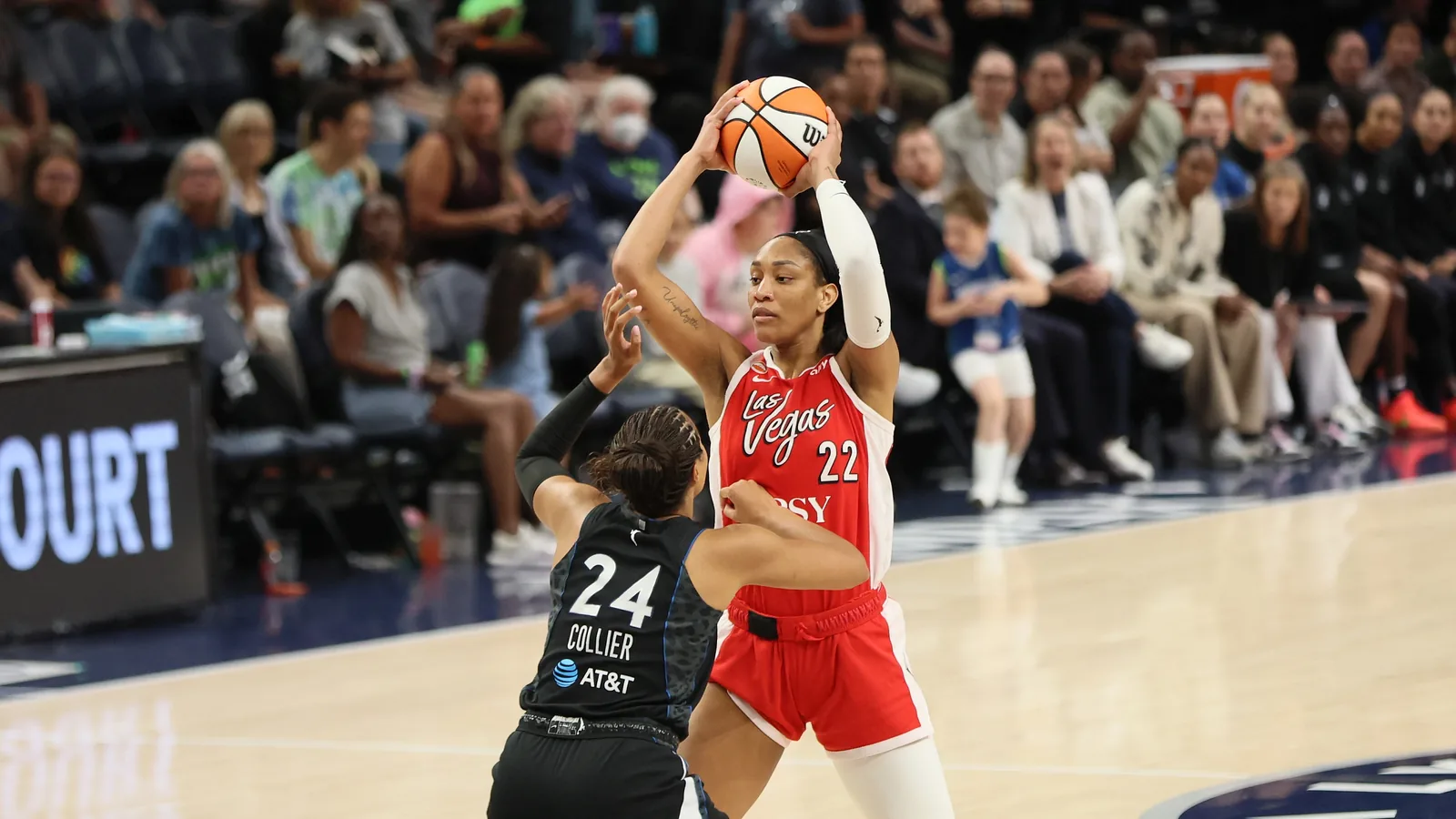
The Aces' problem is deciding who remains around them.
Wilson's listed future salary floats at 20% of the cap. The $1.47 million displayed in the salary table is not the figure used here. She accounts for $1,400,000 at a $7 million cap, $1,500,000 at $7.50 million, and $1,582,000 at $7.91 million (contract sources). Wilson's salary is modeled at 20% of the cap, the supermax, so it scales up as the cap rises, which is why a Loyd-only trade first fits at $8,067,903, above the $7.91 million ceiling, while clearing room under that ceiling requires moving both Loyd and Evans and first fits at $7,811,161.
The other four listed commitments total $2,577,600: Chelsea Gray, Jewell Loyd, Dana Evans and Janiah Barker. Young is a free agent.
If Young leaves
Las Vegas could sign Mitchell at 17% of the cap, keep those five contracts, and budget six minimum positions. The money left above the minimums is $100,800 at an unchanged $7 million cap, $415,800 at $7.50 million, and $674,100 at $7.91 million.
Loyd and Barker are the contracted players who can fill the wing and forward minutes next to Gray, Mitchell and Wilson. Loyd is already paid $840,000. Basketball-Reference lists her as a guard who started 3 of 42 games in 2026 and averaged 8.0 points in 25.9 minutes, so the in-model answer is that she comes off the bench, as she did, or starts if the coaches change that role. She is a scorer. The contract list does not include another player hired to guard a perimeter star. (Aces 2026). Barker is the only other contracted frontcourt player besides Wilson, at the $288,600 minimum. The same page lists her as a forward, and its per-game table does not include her, so this model does not treat her as a proven rotation forward. She can take those minutes or sit if an open spot is upgraded. Evans, at $399,000, is the other contracted guard who can spell Gray. Basketball-Reference lists her in 14 games.
The surplus pays one of the six open spots above the minimum. It does not raise Barker's existing contract. Spending all of it on one open spot, and leaving the other five at $288,600, would pay $389,400 at a $7 million cap, $704,400 at $7.50 million, or $962,700 at $7.91 million. At the unchanged cap, that is not another maximum salary. This comparison does not name a free agent the Aces have not signed.
Gray could still organize the first action, Mitchell could attack off a screen, and Wilson could be the interior target. The cost is Young's departure. Her 2026 averages included 18.9 points, 6.8 assists and 4.4 rebounds. Mitchell's scoring does not replace that combination (team statistics).
If Young stays
Gray, Mitchell, Young and Wilson would be four closing pieces, with Young as another ball handler. The fifth spot is already on the sheet: Loyd on the wing, with Barker off the bench, or Barker in the forward minutes and Loyd off the bench in the role she played in 2026. There is no upgrade money in that version. The shortfall is $1,010,600 at $7 million, $795,600 at $7.50 million, and $619,300 at $7.91 million. Wilson and Young at 20% each, plus Mitchell at 17%, use 57% of the cap before the other contracts and the minimums.
Moving Loyd's $840,000 salary for no returning salary saves $551,400 after a replacement charge. The Aces would still be short by $459,200 at $7 million, $244,200 at $7.50 million, and $67,900 at $7.91 million. Also moving Evans's $399,000 salary saves another $110,400 after a second replacement. That double move leaves $42,500 only at the $7.91 million cap, with seven minimum spots. It is still short by $348,800 at $7 million and $133,800 at $7.50 million (contract sources; FCB calculations).
That is a budget construction, not a reported plan or evidence of a trade partner. Once Loyd is gone, Barker is the remaining contracted forward next to Wilson. The $42,500 at the ceiling is the only leftover in the Young-retained path, and it exists only at that ceiling.
The $67,900 gap after a Loyd-only move at $7.91 million could also be closed by an equivalent cut in the combined modeled salaries of Young and Mitchell. That does not mean either would accept it.
What the semifinal opener showed
Las Vegas scored 60 points on 33.9% shooting in Game 1 at Golden State, and Golden State won the rebounding battle 52-25. The AP recap on WNBA.com called 60 the Aces' lowest point total of the season. Becky Hammon said, "We lost the game on the boards, no question about that." The same recap says Jewell Loyd left early in the third quarter with a left leg injury (Game 1 recap). Basketball-Reference has Loyd at 0-for-2 and 0 points in 16:34, and Young at 11 points on 4-for-15 (Game 1 box score).
Mitchell could be another scorer on a night when a perimeter player is out and the shot is not falling. She does not fix a 25-52 rebounding gap. Young was on the floor for that game and still shot 4-for-15, so the cold night was not only Loyd's absence. One game does not settle the series. Golden State won the next two as well (WNBA playoffs).
FCB assessment: The star pairing is attractive in both versions. The Young-retained version has the more complete basketball case, but it does not fit at any cap tested here without moving more salary. The Young-leaves version fits even below $7 million, with Loyd and Barker as the contracted wing and forward, and a limited pile of money for one upgrade.
Atlanta: another scorer comes with a continuity decision
Atlanta reached Game 7 of the Finals with a roster that already had several ways to influence a game. Jordin Canada organized, Allisha Gray and Rhyne Howard supplied perimeter scoring, and Angel Reese contributed rebounding and interior activity (team statistics; WNBA playoffs).
Adding Mitchell would give that group another defender to occupy and another player to use when an initial action stalls.
The challenge is preserving enough of the existing structure.
Atlanta has $6,180,830 committed to nine listed players. Adding Mitchell at the standard maximum and two veteran minimums leaves a shortfall of $948,030 at $7 million, $533,030 at $7.50 million, and $192,730 at $7.91 million (contract sources).
Three possible routes produce three different teams.
Keep Canada and move frontcourt salary
A proposed closing lineup is Canada, Mitchell, Gray, Howard and Reese.
This is the clearest offensive fit. Canada would continue to organize, Mitchell would provide another scoring threat, and Gray and Howard could attack openings created by the first action.
A Mitchell-Reese screening action would ask the defense to manage the perimeter shot and the interior movement together. If two defenders follow Mitchell, Reese would need to make a prompt decision with the release pass. If the defense switches, Atlanta could choose whether to attack the new matchup or exploit a rebounding advantage.
The physical tradeoff is substantial. Howard would assume some larger forward assignments, and Reese would handle center responsibilities. That could work as a closing option against certain opponents without being the correct lineup for every series.
Moving Brionna Jones or Naz Hillmon would create different amounts of room, but either choice would require a credible plan for the lost frontcourt minutes. Madina Okot's development and the quality of an affordable replacement would matter.
Move Canada and retain more frontcourt size
A proposed group of Mitchell, Gray, Howard, Reese and Jones would preserve more conventional size.
It would also redistribute Canada's organizing responsibilities. Canada averaged 7.3 assists in 2026; Mitchell averaged 2.8. Those figures do not establish that Mitchell cannot create, but they show why adding her should not be treated as a direct replacement for Canada's role (Mitchell statistics; team statistics).
Atlanta would need a dependable answer for advancing the ball against pressure, beginning the first action and getting into a second action when the defense disrupts it.
The risk is an offense with more scoring names but less reliable organization.
Moving Canada for no incoming salary fits at $7.91 million, with $168,670 left, and misses at the two lower caps: short $586,630 at $7 million and $171,630 at $7.50 million. Trading Jones or Hillmon for no salary also misses at an unchanged $7 million cap, by $211,630 and $386,630. The break-even table puts the Jones move first among the Atlanta trades, at $7,254,975. That is still above $7 million. None of those one-player moves is a reported discussion.
Atlanta also traded its own 2027 and 2028 first-round picks to Chicago in the Reese deal. That reduces one source of near-term trade capital without preventing the Dream from making other moves (Reese trade).
Keep all nine and pay Mitchell less
Keeping the nine listed players and two veteran minimums would leave $241,970 for Mitchell at $7 million, $741,970 at $7.50 million, and $1,151,970 at $7.91 million.
At the ceiling, $1,151,970 is $192,730 below the modeled new-team maximum and $430,030 below Indiana's modeled supermax. At an unchanged $7 million cap, $241,970 is $948,030 below the $1,190,000 standard maximum and $1,158,030 below Indiana's $1,400,000 supermax. There is no verified reporting here that she would accept a discount.
Keeping the nine listed players also would not mean retaining every Finals contributor. DeWanna Bonner is among the unsigned players outside that total (contract sources).
What Game 7 showed
Rhyne Howard played 37:37 in the 63-68 loss and scored 6 points on 3-for-14 shooting, including 0-for-7 from three. She also had 3 steals. Jordin Canada scored 18 points with 5 assists, and Allisha Gray scored 16 (Game 7 box score). Atlanta shot 6-for-30 from three (WNBA box score).
Mitchell could be another perimeter scorer on a night Howard's shot is not there. She would not replace Canada's 5 assists, and Howard's 3 steals would still have to come from someone. Mitchell's own three-game series against Las Vegas was 18-for-55 (Mitchell statistics). One closeout game does not mean Howard would shoot 3-for-14 again. Paying Mitchell the standard maximum may also mean moving Canada or a frontcourt player, which is the cap problem above.
FCB assessment: Atlanta has a credible path only after a salary concession or a higher cap. The front office has to weigh Mitchell against the specific player that concession removes. At an unchanged $7 million cap, even trading Jones, Hillmon, or Canada for no salary does not clear the max.
Indiana still sets the financial benchmark
Mitchell's outside options must be compared with what she already has: an established partnership with Clark, continuity with Aliyah Boston, and the opportunity for a higher starting salary.
Beginning in 2027, the signed agreement limits new core designations to players with six or fewer years of service. Mitchell has completed nine seasons, so Indiana cannot use a new core designation to keep her off the market (CBA; Mitchell statistics).
The signed agreement allows the relevant Indiana supermax at 20% of the cap, compared with 17% for a new-team signing. The first-year difference is $210,000 at a $7 million cap, $225,000 at $7.50 million, and $237,300 at $7.91 million. An agreed sign-and-trade cannot provide a first-year salary above the standard maximum (CBA).
That advantage does not determine her decision. It does mean that a new team needs a persuasive explanation of the role, roster and competitive opportunity it is offering.
Golden State can point to a contracted defensive core and to Game 7, when Williams scored 30 of 68. Las Vegas can point to Wilson, with the Young decision deciding whether the roster fits. Atlanta can point to a team that reached Game 7, and to Howard's 3-for-14 in that game, but it has to say who leaves if Mitchell is paid the maximum.
Methodology
The comparison uses the 2027 contract columns of the Her Hoop Stats WNBA Salary Cap Database, checked November 7, 2026 (PST). Those team sheets displayed October 1 updates. The inputs are a snapshot of those public records, not league-certified future rosters and not a report of offers, negotiations, or Mitchell's preferences. The lineups are hypothetical.
The model retains every listed contract and applicable option in the relevant scenario, including unprotected contracts. Unsigned free agents and unsigned draft rights are excluded unless a scenario adds them. Developmental contracts do not fill any of the 12 regular spots. Mitchell's salary is 17 percent of the assumed cap, in whole dollars: cap times 17, divided by 100, with the remainder dropped. Young is 20 percent, cap divided by 5 in whole dollars, only in the labeled retention scenarios. Wilson uses that same 20 percent rule. Las Vegas's other four contracts total $2,577,600.
Each open regular-roster spot costs $288,600 until the roster reaches 12. That figure is the 2027 minimum cap charge for a player with one to three years of service. It is not the cash minimum for every veteran. At the three caps in the first table, 17 percent and 20 percent land on whole dollars, so this whole-dollar formula matches an exact percentage. The break-even search uses the same formula at every dollar in between. A continuous 17 percent and 20 percent, rounded up to the next dollar, is $1 to $4 higher on these nine rosters. The break-even file keeps that continuous figure in the column continuous_round_up_cap. The number in the article is the smallest whole-dollar cap at which the whole-dollar formula is no longer negative. At that cap, the modeled room is $0.
Trade examples assume the recipient takes the entire outgoing salary, nothing comes back, and each vacated spot is filled at $288,600. For Loyd, the net savings are $840,000 minus $288,600, or $551,400. For Loyd and Evans together, the outgoing salary is $1,239,000 and the replacement charge is $577,200.
The $7 million column is the 2026 cap, carried forward with no change. Article VII, Section 1(a) sets that cap at $7,000,000 and limits the 2027 move, up or down, to 13 percent. The permitted 2027 range is therefore $6,090,000 to $7,910,000. The $7.91 million column is that ceiling, not an announced cap. The $7.50 million column is an FCB sensitivity case, not a league projection and not the floor.
These are the rules this model uses, and where they are in the signed agreement:
| Rule in this model | Where it is |
|---|---|
| The standard maximum for a salary-cap year is 17 percent of that year's cap | Article V, Section 8(b) |
| The supermax for a salary-cap year is 20 percent of that year's cap | Article V, Section 8(a) |
| A qualifying veteran free agent with five or more years of service can sign the supermax with her prior team | Article V, Section 8(c) |
| A new contract that the parties agree to trade within 48 hours cannot set a first-season base salary above the standard maximum | Article V, Section 3(f) |
| Beginning with the 2027 season, only a player with six or fewer years of service may receive a core designation in the designation window | Article VI, Section 7(b) |
| The 2026 salary cap is $7,000,000, and the 2027 cap cannot rise or fall by more than 13 percent | Article VII, Section 1(a) |
| Each team must keep 12 players on its roster | Article XXXIII, Section 4 |
| 2027 minimum base salary is $280,800 with zero years of service, $288,600 with one to three, $296,400 with four to six, $304,200 with seven to nine, and $312,000 with 10 or more | Article V, Section 7(a) |
| A minimum contract for a player with four or more years of service counts against the cap at the one-to-three-year minimum | Article I, definition of Salary |
| Before the regular season, a team with fewer than 11 players in its team salary is charged the one-to-three-year minimum for each missing player, up to 11 | Article VII, Section 2(d) |
Article VII, Section 2(d) stops that automatic charge at 11. This model also prices a 12th player at $288,600 because Article XXXIII, Section 4 requires 12 roster players. That 12th charge is a modeling choice about the player the team still has to sign, not a claim that Section 2(d) bills an empty 12th spot.
The model adds no new dead money, trade bonus, unannounced extension, or other transaction charge. It does not establish a willing trade partner, player consent, or a salary a player would accept. A different mix of rookies and veterans would change the budget. Team efficiency rankings use Basketball-Reference's possession estimates, which differ from the league's. No championship probabilities or 2027 win forecasts are assigned.
Data dictionary and reuse
The scenario CSV contains one row per team scenario and cap, including the $7 million cap. It reports the retained contract total, Wilson and Mitchell salaries, any added Young salary, the minimum charge, open positions, modeled payroll, and remaining balance. The salary-input file identifies each player, the source, and the cap hit at $7 million, $7.50 million, and $7.91 million. Wilson is the only player whose hit changes with the cap.
The trade file reports outgoing salary, replacement charge, net savings, and the resulting balance at each of the three caps. In the Loyd-plus-Evans rows, the replacement charge covers two positions. The break-even file reports retained fixed commitments, the cap-share percentage, minimum positions, the whole-dollar break-even, the room at that cap, the continuous round-up for comparison, and whether the break-even sits inside $6,090,000 to $7,910,000. All dollar values are nominal U.S. dollars. A positive balance is room. A negative balance is a shortfall.
FCB's original calculations are free to use and republish (CC0). Scenario CSV, player salary inputs, trade scenarios and break-even caps. Contract inputs are attributed to Her Hoop Stats; the CC0 dedication covers FCB's original calculations, not rights in third-party material.
For corrections to an input or calculation, contact Full Court Buckets.
Sources
- Signed 2026 WNBA-WNBPA Collective Bargaining Agreement, hosted by the WNBPA. The rule-to-source table in the methodology gives the article and section for each cap rule used here.
- Golden State's salary cap sheet, Las Vegas's salary cap sheet and Atlanta's salary cap sheet, Her Hoop Stats. The 2027 columns supply the contract inputs; Wilson's contract-cell note identifies the floating salary.
- Mitchell's season and playoff statistics, Basketball-Reference; cross-checked against Her Hoop Stats' regular-season and playoff pages.
- WNBA's 30th-season record release, October 14, 2026; also NBA Communications' official version. Confirms Mitchell's 1,086-point record.
- 2026 WNBA playoff bracket and format and Finals Game 7 recap, WNBA. Series results, seeding, the 68-63 final, and the 30-24 halftime. Game 7 box score, WNBA, for team shooting. Game 7 player lines, Basketball-Reference.
- Semifinals Game 1 recap, Aces at Valkyries, AP, published by WNBA.com. The 71-60 final, 33.9 percent shooting, the 52-25 rebounding margin, Hammon's boards quote, the season-low description, and Loyd's left leg injury. Game 1 player lines, Basketball-Reference.
- Golden State's 2026 season, Las Vegas's 2026 season and Atlanta's 2026 season, Basketball-Reference. Records, ratings and regular-season player averages.
- Golden State All-Defensive selections, Valkyries team release, October 15, 2026.
- Fever backcourt season release, republished by OurSports Central, October 24, 2026. Source for 96 of Clark's 333 assists going to Mitchell. The directly linked Fever page exposed only its title in this review, so the accessible republication was checked for the full text.
- Atlanta acquires Reese, Dream team release, April 6, 2026. Draft consideration in the Chicago trade.
- Kelly Krauskopf to step down as Indiana Fever team president, Pacers Sports & Entertainment release, October 23, 2026.
- Pacers Sports & Entertainment announces departure of Amber Cox, Fever team release, October 23, 2026.
Update, November 7, 2026, 10:34 p.m. PT: Added the unchanged $7 million cap, moved the break-even caps above the team sections, and replaced the open Aces lineup spots and the generic playoff paths with contracted players and sourced 2026 games. Wilson's salary is still 20 percent of the cap.
Update, November 7, 2026, 11:50 p.m. PT: Added section anchors, the 2027 free-agency calendar, the October 23 Fever front-office announcements, and the first-year supermax gap in the opening summary. The byline date is the November 7 Pacific publish time.
AI assisted research and editing. Full Court Buckets is responsible for the published analysis. Sources and calculation methods are provided above. How we make Full Court Buckets
Full Court Buckets · WNBA News. Analysis. Commentary.