
How the Valkyries’ league-best defense takes away the next option, not just the first

Golden State finished the 2026 regular season 32-12 with the WNBA’s best defensive rating, 99.1 points allowed per 100 possessions, then held A’ja Wilson to 41.1% shooting in a semifinal sweep of Las Vegas (she shot 52.7% in the regular season). Two possessions, one against Caitlin Clark’s Fever and one against Breanna Stewart’s Liberty, show how: the first rotation takes away the easy play, and the next defender is already moving before the offense finds the second one. That habit is what Atlanta has to beat starting with Game 1 of the Finals on Saturday, Oct. 17.
- 99.1 regular-season defensive rating, 1st in the WNBA (team release)
- 104.1 playoff defensive rating, 2nd behind Atlanta’s 102.0 (same release)
- 79.8 points allowed per playoff game, fewest (same release)
- 41.1% Wilson’s field-goal percentage against Golden State in the semis, down from 52.7% in the regular season (same release)
Jump to: Early offense · Middle offense · Finishing the stop · How offenses can attack it · What it means for the Finals
Small-sample note: the film covers two possessions. They show habits, not how often each coverage works. The season numbers above are the evidence for the overall result.
Film credit: breakdown by Jeremy Lin (@jlin7 on TikTok, posted Sept. 16, 2026; also on Instagram). The clips are described here. This page does not embed the video or republish stills.
| Phase | What Golden State does | What the offense loses |
|---|---|---|
| Early offense | Gets bodies between the ball and the rim | The clean transition drive |
| Middle offense | Helps on the first action, then resets as the ball moves | The easy roll pass and the next driving lane |
| Finishing the stop | Finds the rebound threat before chasing the ball | A simple second chance |
1. Early offense: take away the first clean drive
In Golden State’s 79-60 win at New York on Aug. 27 (Valkyries up 46-34, 7:20 left in the third quarter), Stewart catches in transition with room to attack. By the time she squares up, Golden State’s retreating defenders are between her and the rim, so driving means driving into traffic. She passes, New York swings it, and the possession ends in a corner three.
That’s a win for the defense in one specific way: it removed the first clean option and made the Liberty use more passes. Whether a corner three is a good trade depends on the shooter and the contest, and the clip alone can’t settle that.
What to watch: where the defenders land as the ball is caught. If those first steps are late, help never matters.
2. Middle offense: help, recover, help again
In Golden State’s 88-75 win at Indiana on July 15 (Valkyries up 20-18 in the second quarter), Clark runs a pick-and-roll, moves the ball, gets it back and attacks a closeout. Golden State has to defend four actions in one trip.
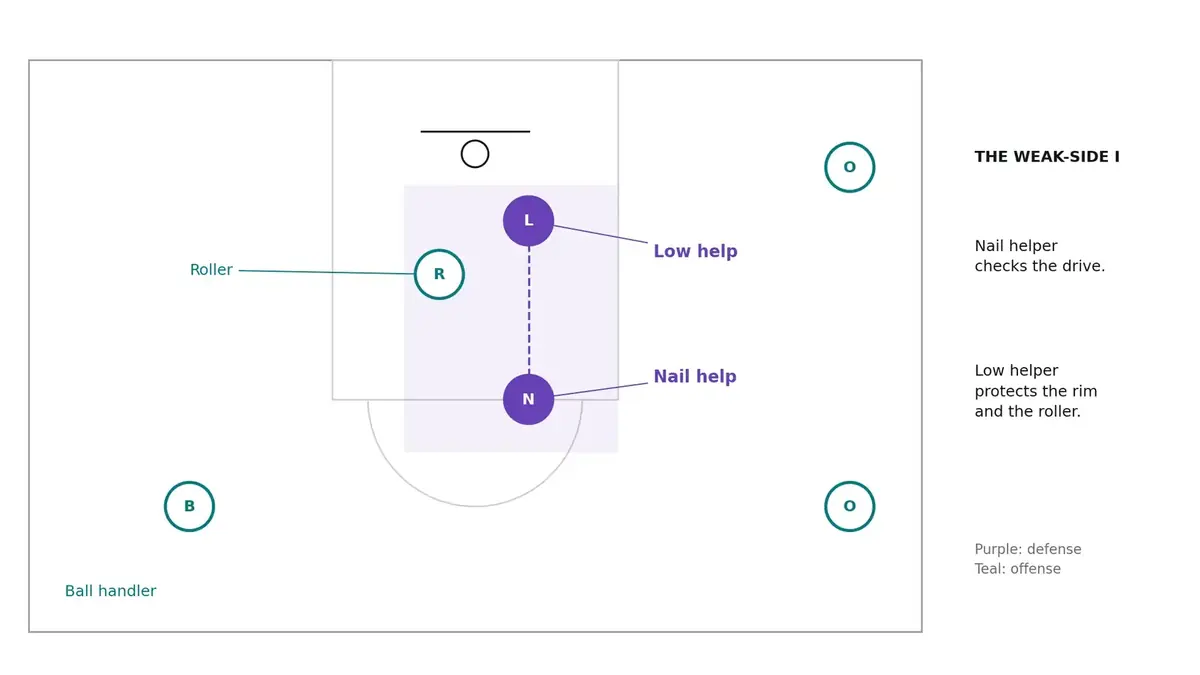
The weak-side I puts help at two depths
As Clark comes off the screen, one helper sits at the nail (the middle of the free-throw line) and another sits low near the rim. The higher one discourages a middle drive. The lower one protects the rim and the roller. With both jobs covered, the pocket pass to the screener isn’t there, and Clark swings it across the floor. The diagram at the top of this story is that shape. The spots are a schematic, not tracking data.
The skip pass starts the next job
A skip pass is supposed to beat the first layer of help. Here it doesn’t, because Tiffany Hayes gets back toward the nail while Indiana attacks off the catch. The ball goes back to Clark, now attacking a defender closing out on her.
Clark attacks the closeout and finds another crowd
Clark drives the gap and three nearby Valkyries shrink her shot and passing windows. The trip ends in a turnover. The shape looks like a triangle in that moment. One clip isn’t enough to call it a zone or a standard coverage.
3. Finish the stop: find a body before chasing the ball
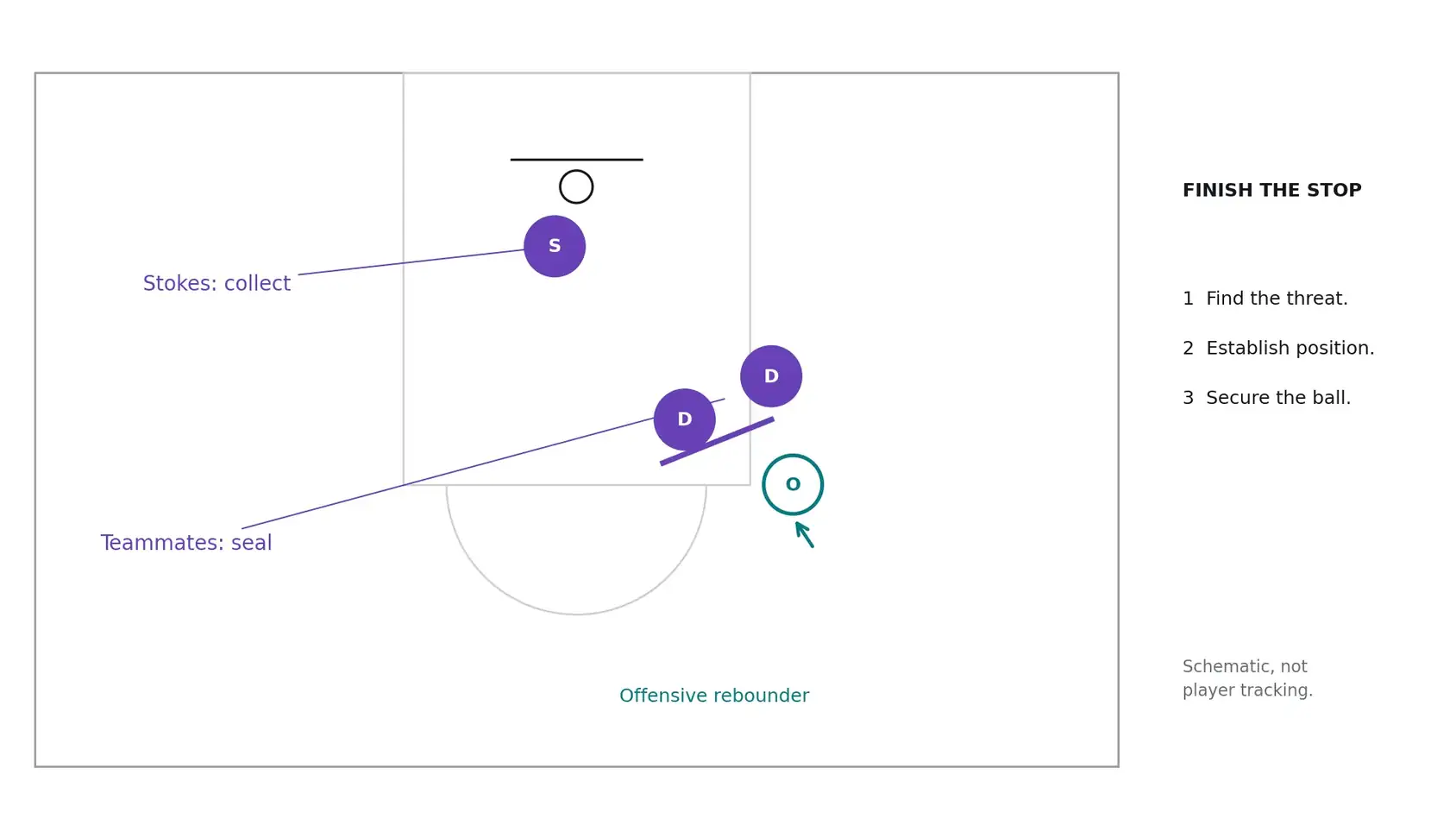
Back to the Liberty possession. When the corner three goes up, three Golden State defenders turn to find their man first. Two of them put bodies on Stewart, and Kiah Stokes collects the miss.
Stokes gets the rebound in the box score. Her teammates made it available. That matters against Atlanta, which our Game 1 preview shows wins with pressure while Golden State wins on the glass.
The personnel behind it
The team’s September awards case names Gabby Williams and Veronica Burton as its perimeter defensive leaders and Stokes as the backline anchor. That Sept. 23 release listed her second in the league with 73 blocks. She finished the regular season second, with 74 blocks in 43 games. In both clips the decisive defender, Hayes recovering or a teammate pinning Stewart, never touches the ball.
How an offense can attack it
These are my reads from the spacing in the clips, not plays shown in the video.
- Move it before help resets. Catch-and-shoot or catch-and-drive right away, before the helper reaches the nail.
- Make the weak-side helper choose. A cut behind her, timed with the drive, makes her guard two things. Cut too early and you just add a body to the lane.
- Use the screener as a passer. If the roll is covered, the short roll puts the decision in the screener’s hands.
- Punish help with shooting and a surprise rebounder. It costs transition defense at the other end.
What it means for the Finals
My pick (as of Oct. 14): Atlanta’s best path is the first counter, quick decisions before Golden State’s second rotation arrives. The Dream had the playoffs’ best defensive rating (102.0), so this series is likely to be decided by which offense creates a clean second option. Follow the numbers game by game in our 2026 WNBA Finals ratings tracker and the Valkyries team page.
Season and playoff figures: Golden State Valkyries team releases (Sept. 23 and Oct. 13, 2026), checked Oct. 14, 2026 PT. Film concept credit: Jeremy Lin (@jlin7), Sept. 16, 2026. Game results gathered and verified by Full Court Buckets. Clip scores and records were read from the broadcast scorebugs in the video. Diagrams are original Full Court Buckets illustrations.
How this story was made: drafted with AI tools from the sources linked above, then reviewed and edited by Ryan Moalemi. How we make Full Court Buckets
Full Court Buckets · WNBA News. Analysis. Commentary.